For coaches, consultants and experts who sell on camera

Your personal editor. B‑roll from your real footage, nothing fake.

B-roll only from what you recorded: no stock, nothing generated.

Try it on your own clip Start free with Google

First video free. No card.

Runs in Chrome on a laptop or desktop.

On a phone, sign in too and your free first video is saved for your computer.

What does editing one video cost you?

Hound, Takehound's green dinosaur, standing on the video window and smiling
Takehound · my talk · Hound's cutpublished

My own talk, made with Takehound. Hound did the first pass, then I told him what to change in plain words.

Before anyone finishes itMy own recording from 31 October 2026, cut on 1 November 2026, and nothing in it was changed by hand.

What Hound's first pass looks like, untouched.

My recording · as recorded19.1 s

on how I have borrowed ideas. Now, when we have problems, a false start: 8 words, 8.8 seconds We can look at different industries, find similar problems

Hound's first pass · untouched10.3 s

on how I have borrowed ideas. Now, when we have problems, We can look at different industries, find similar problems

  • 12:14my recording
  • 9:08Hound's first passNo B-roll in this pass, and Hound flagged the two pictures he added as not my footage.
  • 122stretches cut out105 are silent gaps and 17 have words in them, the longest 1:22.
  • 188words cut, of 1,835
  • 19 min 45 sone press to the first passThe clock starts once the words are written down, and no finishing time was recorded for this video.

Then you tell Hound what to change.He ended this pass by naming 3 spots he thought I should check. Try a clip of your own

He watches the cutOn a talk, Hound watches your cut as moving picture and sound before he changes anything, and again after.

A transcript isn't the cut. He watches and listens, like an editor.

  • Sound

    He hears where a cut lands

    He listened to all 19 cuts, heard one that clipped the word “it”, and put the word back.

  • Movement

    He sees what your hands do

    He took one of my lines back off the screen where my hands came up into the frame.

  • Picture

    He sees what is already there

    Over my hiking clip, he took his own push-in back.

Why not just use ChatGPT or Claude?

Try it now, no sign-up

Watch your own clip lose its dead air.

Pick a clip where you talk, up to two minutes.

Only the sound is sent.The picture is not sent, and the small copy of the sound on Takehound's own server is deleted once read. Privacy

One video, start to finishEvery picture is a screenshot of him at work on my own talks, on November 2.

Here is the job. Hound takes it.

  1. You hand him the talk and your clips.

    Then one press: Do the whole first pass.

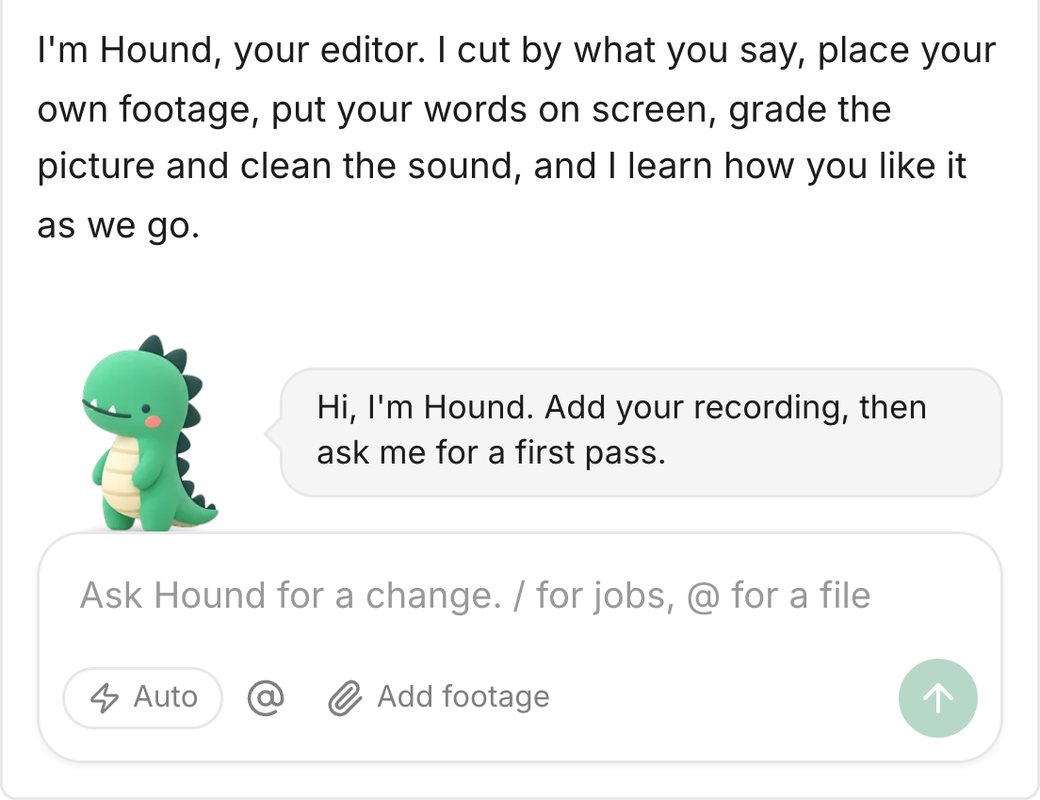
    Takehound's Hound panel in a new project: Hound says what he does as your editor and asks for your recording
    What he says in a new project.
  2. He works while you watch.

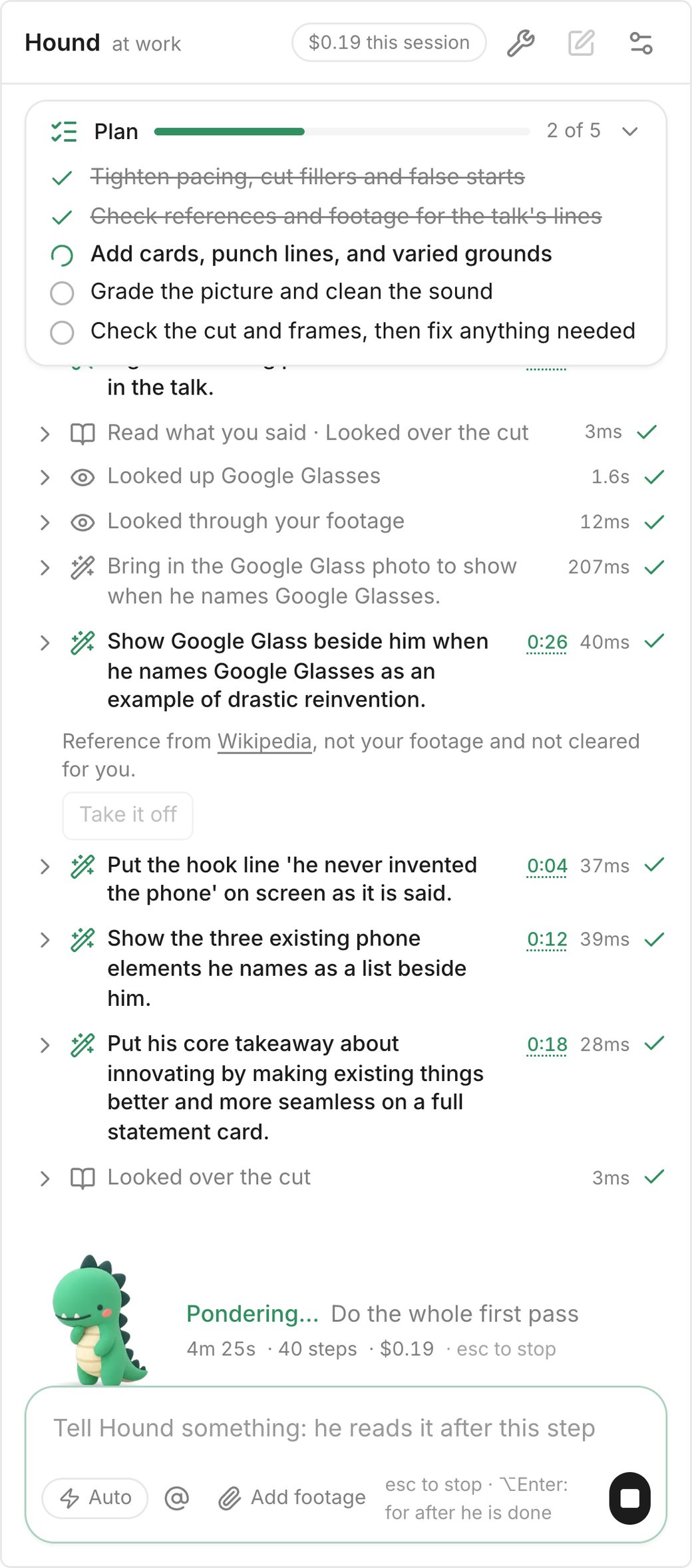
    The pauses, the ums and the retakes come out. Your own clips, never stock or generated, sit where you talk about them, and where none fits he leaves a gap. Your key lines go on screen in your own words. Type to steer him, or press Esc to stop him.

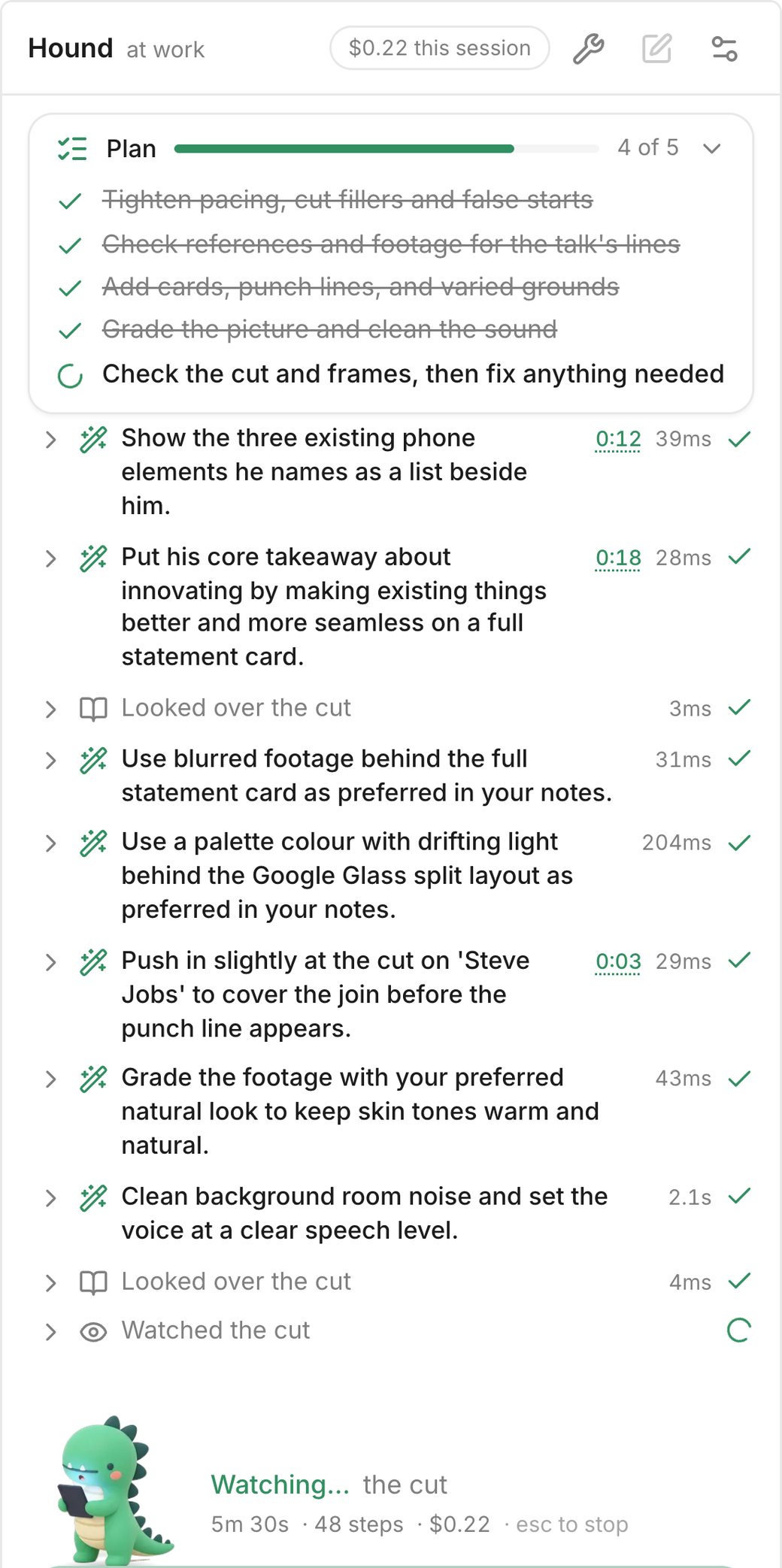
    Takehound's Hound panel mid-job: Hound's plan for a first pass of Kyle's next talk, each step he has taken, and Hound pondering the next
    Mid-job: his plan, and each step he has taken.
  3. He says why, and marks the moments.

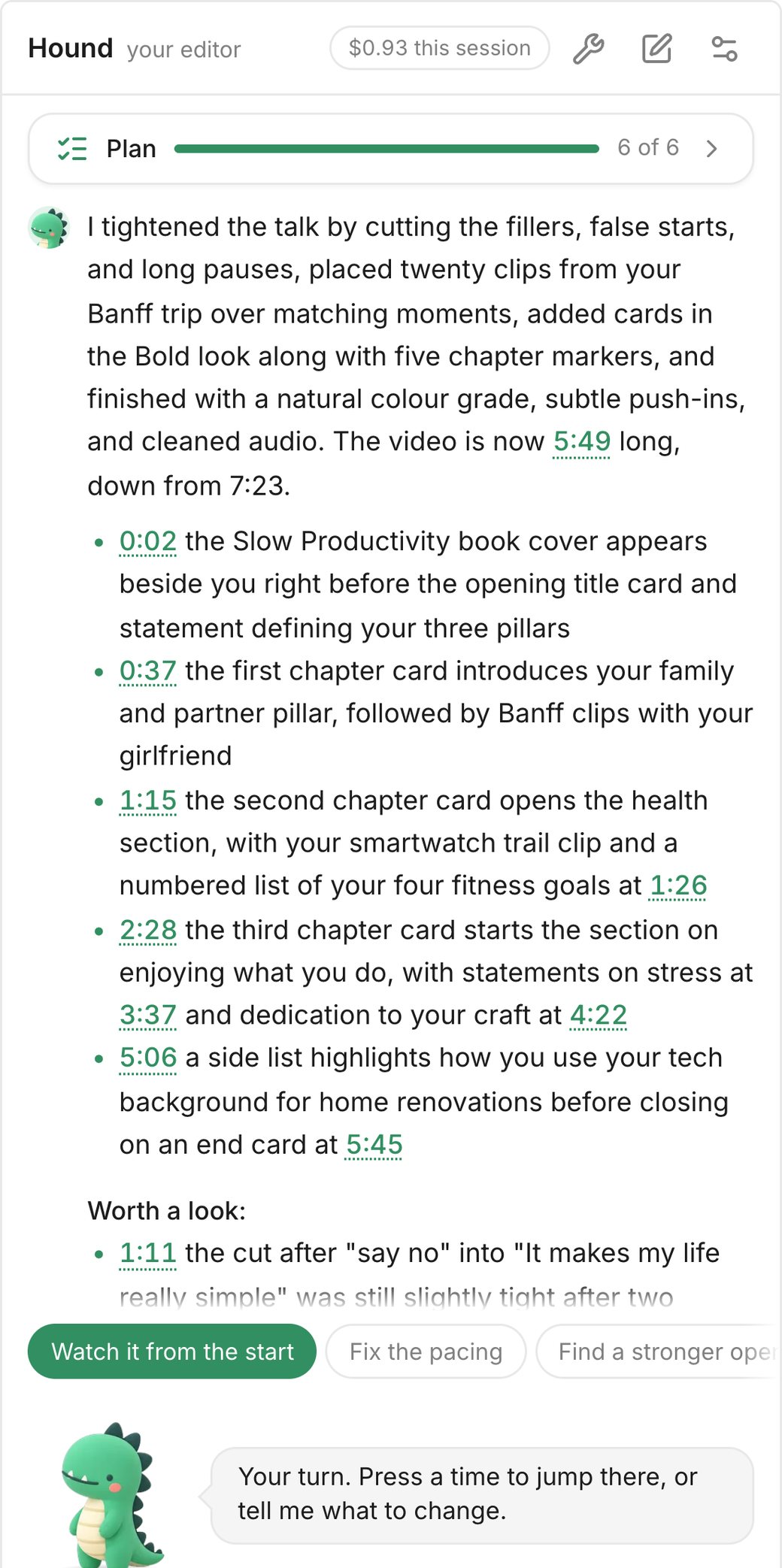
    He works with a reason for every change, in plain words, so you can overrule him fast. Press a time and the playhead goes there.

    Takehound's Hound panel after the first pass: Hound's report on Kyle's talk, 7:23 down to 5:49, each moment a time you can press
    His report on my 7:23 talk: 5:49 now, and two things worth a look.
  4. You tell him what to change, in plain words.

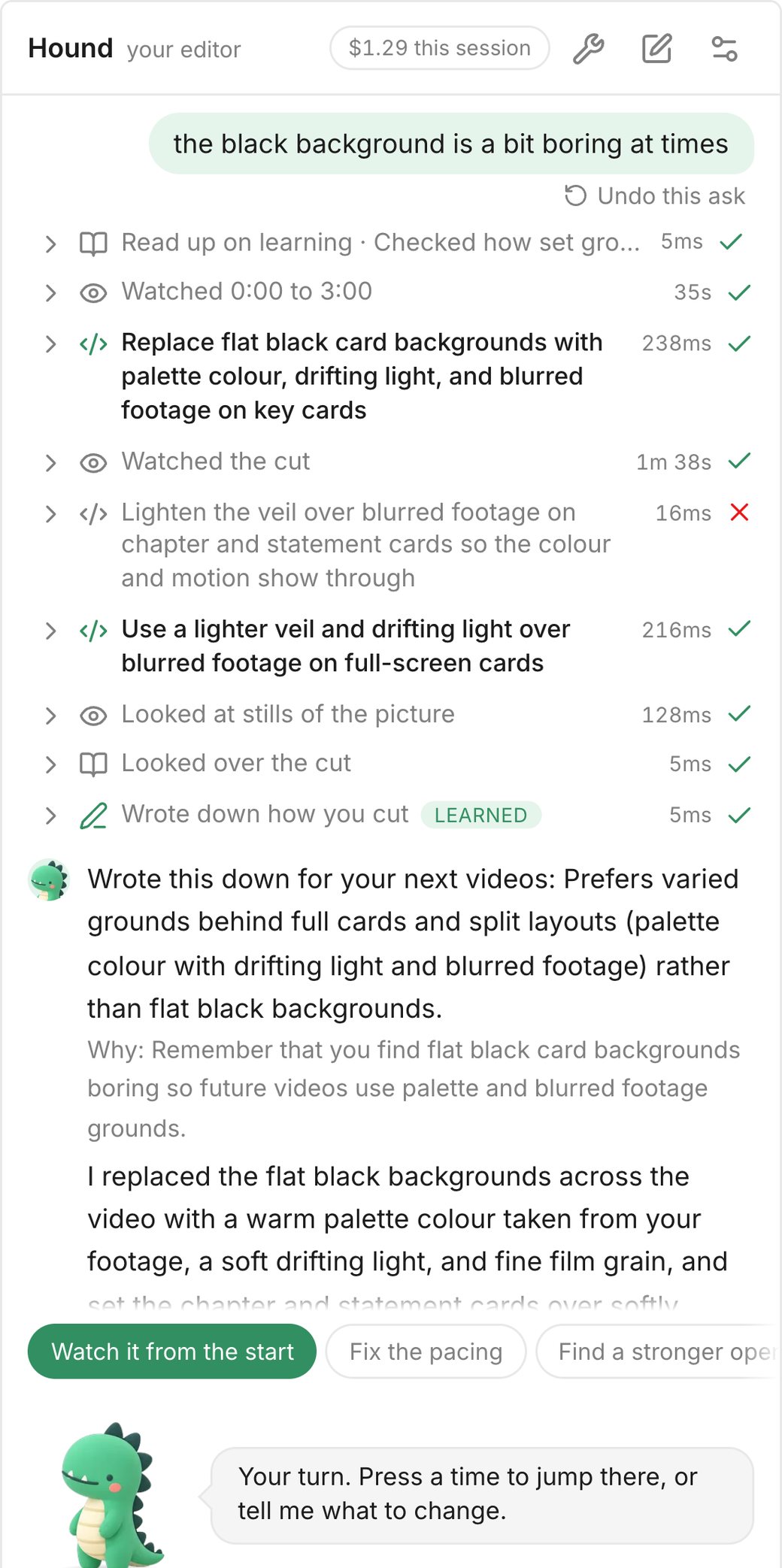
    I typed: the black background is a bit boring at times. He changed the cards and said what he did. Any ask comes off in one step: Undo this ask.

    Takehound's Hound panel after an ask in Kyle's words: the steps Hound took on the card backgrounds, and the line he wrote down for the next video
    My ask, and each step he took.
  5. He writes down what you tell him.

    It goes in his notebook, in plain words. You can read it and take any line out.

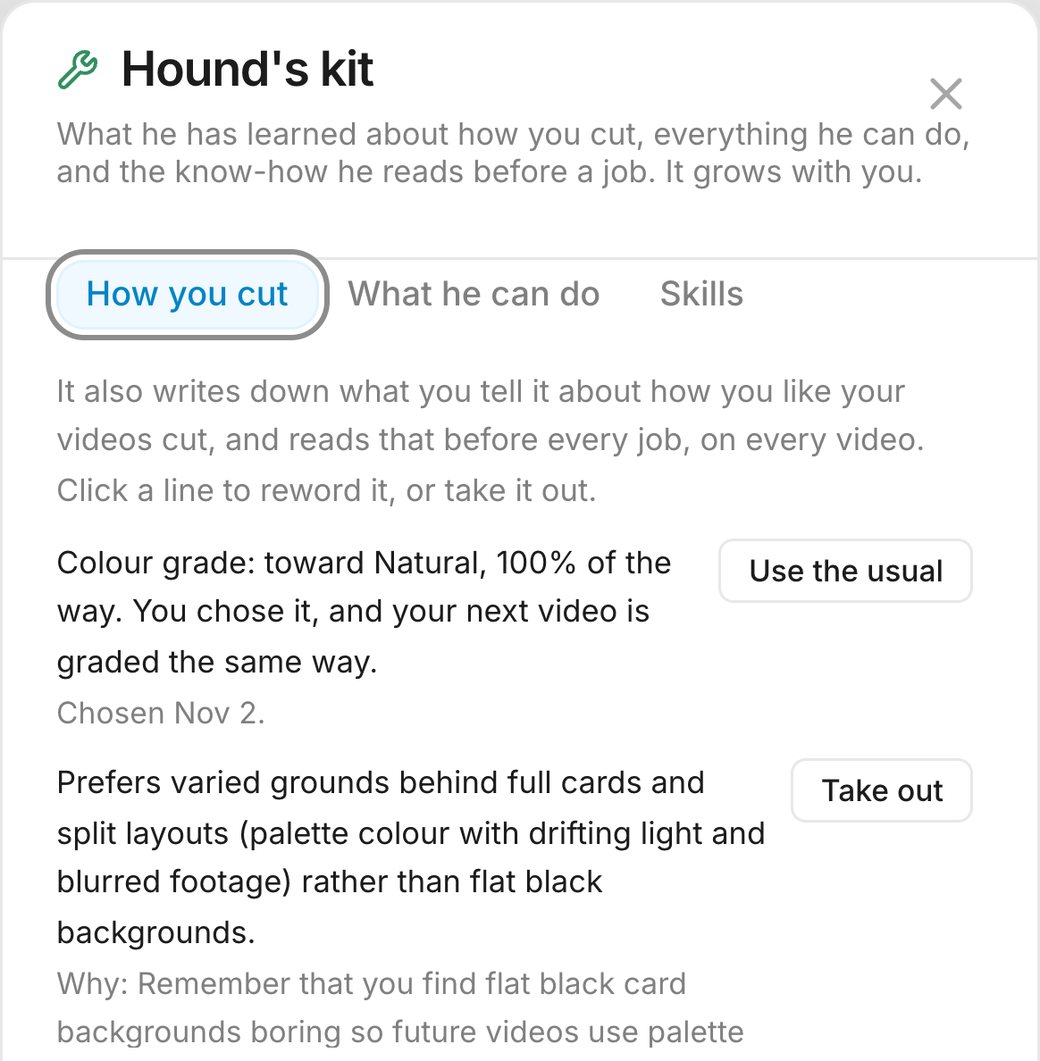
    Takehound's kit, How you cut: the notebook line Hound wrote from Kyle's ask about black backgrounds, and the grade he keeps for the next video
    The line he wrote from my ask, with Take out beside it.
  6. The next video starts there.

    He reads his notebook first. The look, the grade and the sound you chose last carry over too.

    Takehound's Hound panel on Kyle's next talk: Hound sets the card backgrounds and the grade as preferred in his notes, then watches the cut
    The next talk: he set the cards and the grade from his notes.
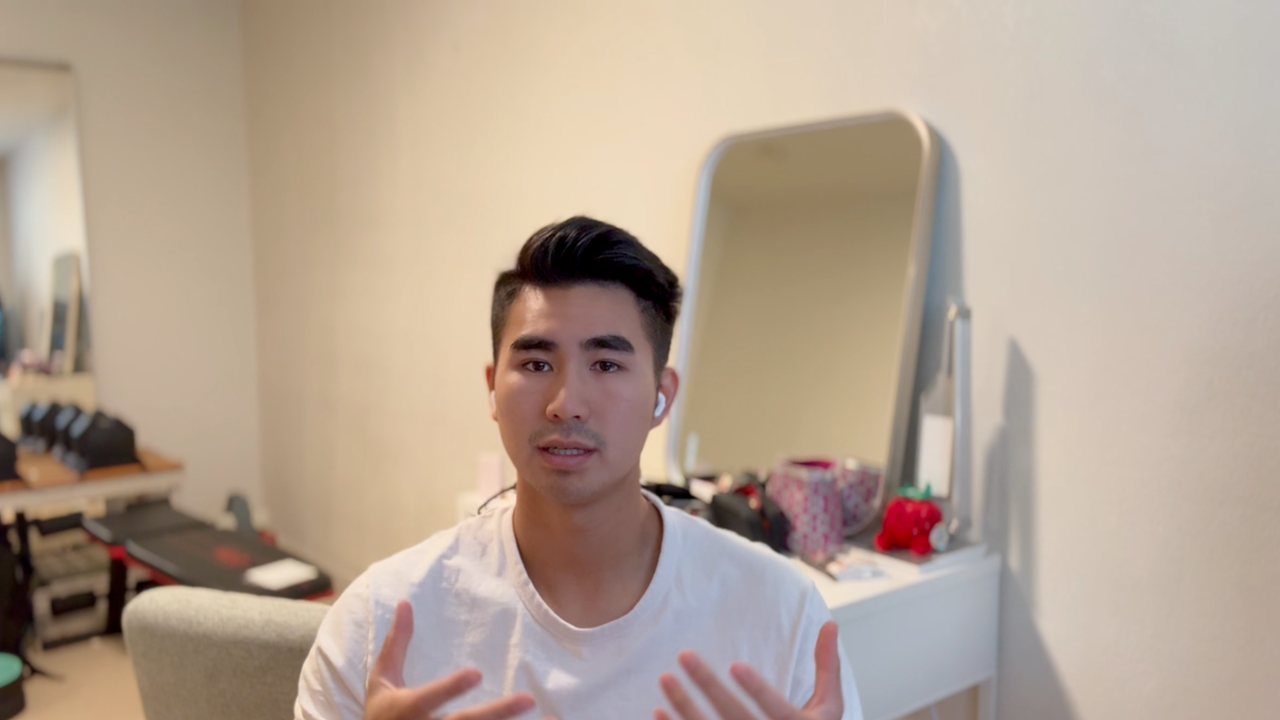
Kyle's raw recording at 0:50, talking to camera in his room, before Hound cut it in Takehound

As I recorded it, at 0:50

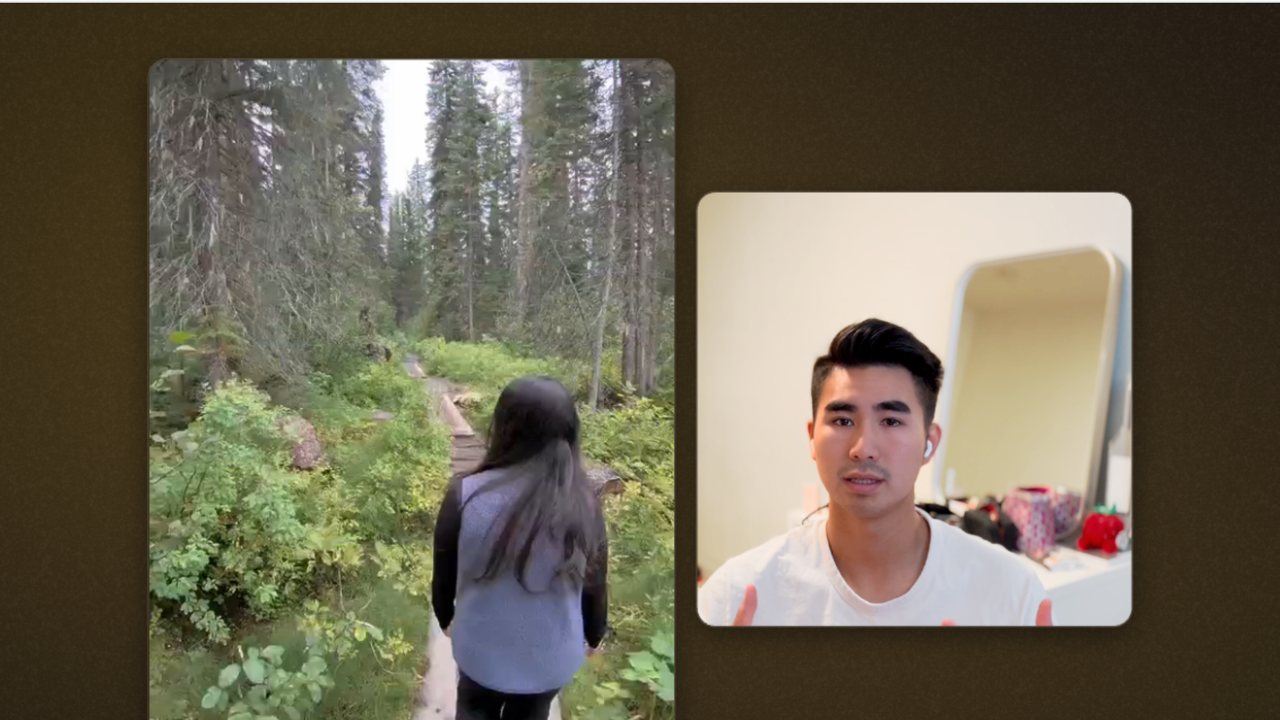
Takehound's cut by Hound at the same moment: Kyle's clip of a forest trail beside him, on a warm colour taken from the video

Hound's cut, at 0:42

The same moment of my talk. The recording ran 7:23, his cut 5:49.

The story and the taste stay yours. Finish in the browser and export an MP4, or open his timeline in DaVinci Resolve.

The bill

Hound is your own, costs less, and learns how you like your videos cut.

  1. Your own

    He works on your video while you watch, and takes your changes in plain words.

  2. Cheaper

    About $10 to $12 a video on a monthly plan, where an editor costs about $45 to $327 for one.

  3. Better the more you work with him

    He learns how you cut. He remembers how you like your videos, and the next one starts from that. What he remembers

A human editor

About $45 to $327 a videoPrices that editors and editing subscriptions list on their own pages, with sources in Video editor cost per video.

Or an editing subscription of $500 to $2,700 a month.

  • Your video waits in their queue
  • You brief them again on every video
  • Changes go back and forth by message

Hound, in Takehound

About $10 to $12 a videoFor 15 minutes of recording with two rounds of changes, on a monthly plan ($50, $100 and $250 a month).

Your first video is free. After that, monthly plans are $50, $100 and $250 a month, and credits you do not use roll over.A recording up to 30 minutes with your notes on it, and no card.

  • A first pass in minutes, while you watch
  • Starts the next video from what you told him
  • Takes changes in plain words, and any of them back
Open the editor

Sign in with Google to start.

What editing costs, in other people's words
“I was spending like 10 to 20 hours a week editing videos while I was working full time.”
Ali Abdaal, Mixergy interview
“I want to delegate editing my YouTube videos, but every time I do that, the quality is miserable. I keep firing them. I keep having this back on my lap.”
Simon Severino, on what operators tell him, 1 August 2024
“I pay $2,500-3,000/month for 4 long-form videos plus 20 shorts.”
Robert Forrester, LinkedIn
Public interviews and posts, each linked, and none of them are customers.

Templates

Start from an edit someone already worked out.

  • Tight opening

    Makes the first thirty seconds earn the next thirty: the strongest line first, no dead air, and the title on screen.

  • Warm studio

    A lamp-lit studio: warm whites, deeper blacks and a little more colour in the room, with your skin as it was shot.

  • Navy business

    White capitals and an amber accent on deep navy, for business talks that make one point at a time.

See every template

FAQ

Questions

What leaves my computer, and what is kept?

Cleaning the sound and grading the colour happen in your browser, and no sound and no picture is sent for them. Each of these is sent when you press its button. The review after the first pass is the one exception: it sends a small copy of your cut, picture and sound, to the same models without another press.

  • Transcribe sends the sound of your recording to Takehound's server, which turns it into words and deletes the sound once it has been read.
  • Describe my footage sends a few small stills of each clip through Takehound's server to Anthropic's API, which describes them. They are not kept.
  • The first pass sends the same as an ask (below) to the model that makes it: Gemini for a story, Anthropic for a lesson. Past the day's spending limit, a story's pass is made by Jev, a decision model made by TypeSafe AI, from the words, the clip descriptions and what you told Hound alone: your file names and the times go no further than Takehound's server.
  • Any ask sends the words of your recording, a description of your timeline (file names, times, text on screen), your notes, what Hound has learned about how you cut and a few small stills of your video as it stands through Takehound's server: for a lesson to Anthropic's API, for a story to Google's Gemini model, with a small copy of your cut, picture and sound.

What goes to Anthropic's API may pass through OpenRouter on the way, and what goes to Jev or Gemini always does; OpenRouter relays it. Takehound's server keeps none of it, and nothing you send is used to train a model. Your projects and what Hound learns are kept in your browser. With an account they are kept with it too: each cut's timeline, its reasons and notes, the words and your file names, not the video files. Those are uploaded when you are signed in, because footage storage is on for every signed-in account, so your footage library is there on any computer you sign in on. Delete a project from your list in Takehound, clear what it has learned in the Takehound panel, and Delete this account removes everything an account keeps. Privacy has every detail.

Takehound can't check who agreed to be filmed, so only use footage you have the right to use.

Why not just use ChatGPT or Claude?

A chat assistant can tell you what to cut, and a coding tool can run the cuts on your computer if you set it up. Then you are the one watching every render and fixing it.

Hound does that checking himself: he watches and listens to the cut. He works in a timeline you can see, where every step can be undone, and he remembers what you told him on your last video. There is nothing to install and nothing to run on your computer.

Does Hound replace my editor completely?

He takes the editor's work on the cut. What stays yours is the taste: the story, what to stress, and the last look before you publish. He does not decide what your video is about.

Takehound is a tool you run yourself, not an editing service: no person edits your video. If you keep an editor for the last part, hand them his timeline to open in DaVinci Resolve.

What does Hound remember about me?

Three kinds of thing, and you can read them in his panel, under How you cut:

  • what you told him in words about how you like your videos cut, as lines in his notebook;
  • what he saw you take back or have redone: how long a pause you keep, and whether you want push-ins at the cuts, and how far;
  • the look, the grade and the sound you chose last.

He goes by them on every job. Take a line out, or forget all of it, and he stops going by it. They are kept in your browser, and with your account when you are signed in.

Do I need an account?

Yes. Sign in with Google and Takehound opens. Your account keeps your projects, what Hound has learned about how you cut, the look you chose, your footage logs (each shot's description and your file names) and, while footage storage is on, your footage library, so all of it is there on any computer you sign in on. Delete this account, on the account page, removes all of it.

What computer do I need?

A laptop or desktop with Chrome. Takehound needs a wide screen, so it is not made for a phone or a tablet, and it works best in Chrome.

Footage from your phone works. Copy the clips to your computer first.

Can I finish it in DaVinci Resolve?

Yes. Save the timeline file and open it in DaVinci Resolve (free), then point it at the folder your footage is in: the clips come back online and your cuts come in placed, with the words on screen as titles you can edit. It does not export to Premiere. Its timeline file has not been opened in Final Cut.

Or finish in the browser and export an MP4. The import steps, and what to do if a clip shows as missing, are in how to import FCPXML into DaVinci Resolve.

What does it cost?

Nothing for your first video once you are in, a recording of up to 30 minutes, and the notes you give on it. There is no card, so nothing is charged and nothing renews. More videos use credits, and they never expire.

Start free

Hand Hound your next video.

Start free with Google

Sign in with Google for a free first video. No card, no install.

Hound, Takehound's dinosaur, jumping with both arms up