Guide
How to edit a talking head video with B-roll
Stay on the speaker unless you have a shot that shows what the line says. Here is that rule on one real 50-second cut, with its timings.
Have a recording? Try it on your own footage: Hound makes the first pass with your clips and says why for each one. Your first video is free, no card.
The test
Cut away, or stay on the speaker?
I'm Kyle, and I'm not an editor. Run each line of your script through this test.
| If the line | Then |
|---|---|
| Opens the video | stay Let people see who is talking first. |
| Names a place, a thing or an action you filmed | cut away Show it. |
| Is an idea, and one of your shots says it with the sound off | cut away Check it muted first. |
| Is the claim or the ask you most need believed | stay Say it to the camera. |
| Has a jump cut to hide | cut away Lay the shot over the join. |
| Fits nothing you filmed | stay No cutaway beats a wrong one. |
| Only fits a shot with a client in it | stay Unless they have agreed to be shown. |
A real cut
One 50-second talk, cut by cut
This is my own talk about a book on doing less, cut with footage from one trip. Takehound, the tool I built, proposed the cutaways and gave a reason for each.
Cut from my recording with the Mac version of Takehound. Best of three runs. The browser version cuts from a recording too.
-
0:00 to 0:08
On me
The opening line names a book. I had no shot of one. -
0:08 to 0:13
Hikers climbing a forest trail cutaway, 5 s
Takehound: “Hikers climbing steadily up a forested mountain trail show working toward chosen goals.” -
0:13 to 0:17
On me
I finish the thought and ask “What does that mean?” -
0:17 to 0:21
A hiker stopping at a trail sign cutaway, 4.5 s
Takehound: “A hiker pausing at a trail sign suggests stopping to choose what matters most.” -
0:21 to 0:28
On me
The line about saying no. Nothing I filmed showed it. -
0:28 to 0:33
Walking up to a waterfall cutaway, 5 s
Takehound: “Walking up to a waterfall and stopping to photograph it shows everyday creativity and enjoyment.” -
0:33 to 0:50
On me
Two more cutaways were proposed here. I removed both.
7 lines, 5 cutaways proposed, 3 kept.
Pacing: open on the speaker
- It opens on me for 8 seconds and ends on me for the last 17. For a longer talk, the Tight opening template lists five steps for the first 30 seconds.
- The speaker starts the line. Each cutaway comes in about a second after its line begins.
- Hold it long enough to read. Mine ran 5, 4.5 and 5 seconds, and each was gone by the next idea.
- Come back to the speaker between cutaways. Here, for about 4 and 7 seconds.
- B-roll is the smaller share: 14.5 of the 50 seconds.
Match the picture to the line
Ask what a viewer should see while they hear the line. A literal match is safest: the line names a trail, you show the trail. Otherwise a shot can stand in for the idea, if it still makes sense muted.
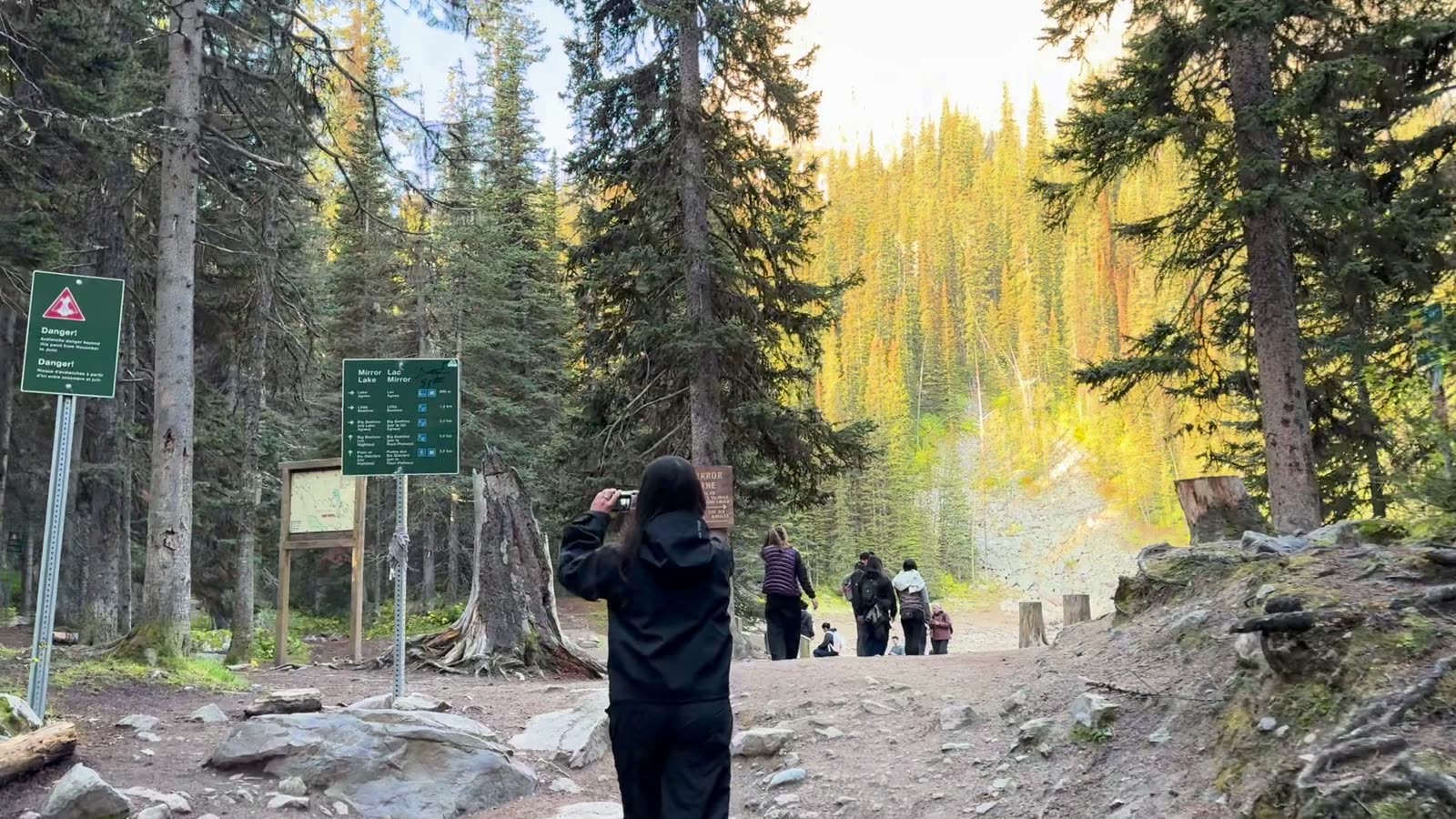
My script asked for desks and notebooks. I had mountains. The line-by-line account is in B-roll ideas for coaches. To see what your own script asks for before you film, paste it into the free B-roll shot list generator.
A wrong cutaway is worse than none
A cutaway tells the viewer “this is what I mean.” When the picture shows something else, they are left working out why. Staying on the speaker avoids that.
I removed two of the five:
- “…enjoy my life outside of work.” A canyon walkway, where a crowd of strangers was the whole picture.
- “My first one is my family and my partner.” Picked as a couple by a lake. It opens on a trail-work sign, then shows the back of one head. The couple never appears.
Both lines stayed on me. And if a client appears in a shot, get their consent before you use it.
The same cut in any editor
Cutaways are one of three jobs on a talk. What a talking head video is shows the other two, cutting the pauses and putting words on screen, on the full 7:23 talk this cut comes from.
- Finish the words first. Cut the pauses and retakes before any B-roll goes in.
- Split the script into lines, one idea each. Mine had 7.
- Write the picture each line asks for, then look for it in your footage. No match means the line stays on you.
- Put each cutaway on the track above the talking head and mute its sound, so your voice keeps playing. Final Cut: Edit > Connect to Primary Storyline (Apple's guide, read 2026-10-03). DaVinci Resolve: the “place on top” edit (Blackmagic's edit page, read 2026-10-03).
- Trim to the line. Start a beat after the line begins and end by the time the line ends.
- Choose the in-point. A clip's first seconds are often the camera settling. My three cutaways start 3 to 8 seconds into their clips.
The finishing pass
- Watch once with the sound off. Does each cutaway still make sense?
- Listen once without looking. No cutaway's sound should leak under your voice.
- Check the first and last frame of each cutaway, where a sign, a stranger or a blur hides.
- Compare the color of each cutaway with the talking head.
Where Takehound fits
Steps 1 to 4 are the cutting, logging, finding and placing. Hound, the editor in Takehound, does that 80% in your browser and learns how you cut. The 20% stays with you: story, taste, the final cut.
A transcript isn't the cut. On a talk, Hound watches your cut as moving picture and sound before he changes anything, and again after: he hears where every cut lands, sees what is already on screen, and checks each clip he placed against the words you say over it.
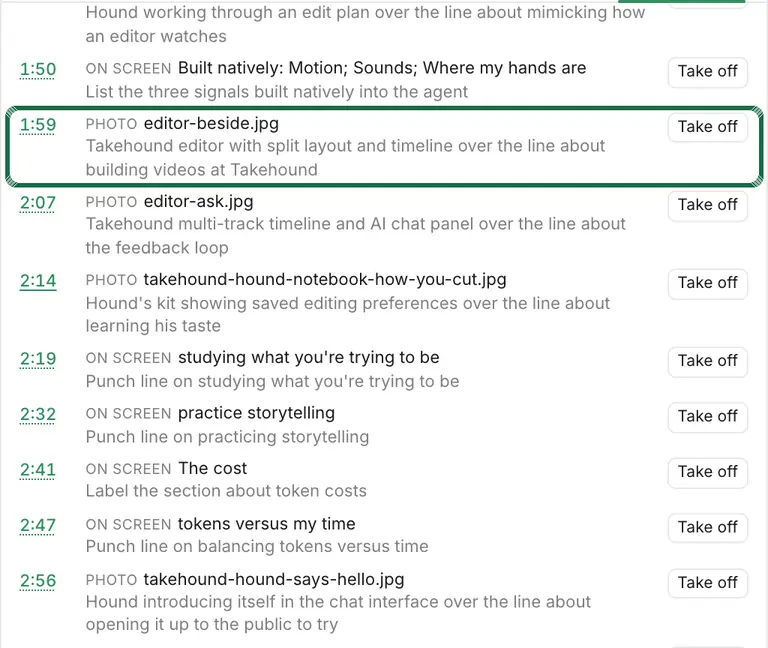
Press one button and watch him make the first pass: he cuts long pauses, filler words and repeated takes, places your own clips, photos, slides and screen recordings where you talk about them, and puts your key lines on screen, each change with its reason in a feed. B-roll is only your own footage, and a line none of it fits stays on you. Steer him in plain words, undo any step or edit by hand, then export an MP4 from the browser, or a timeline (FCPXML) for DaVinci Resolve, not Premiere.
Sign in with Google for a free first video. See privacy.
Other tools place your own clips too: AI B-roll from your own footage compares nine of them.
See how Takehound works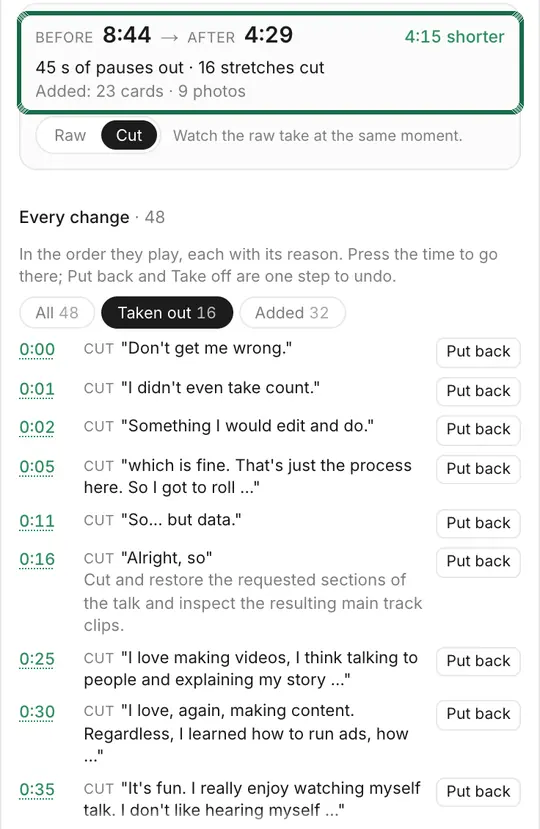
Questions
How long should a B-roll cutaway be?
Long enough to read the picture, and gone by the next idea. In my 50-second talk the three cutaways ran 5, 4.5 and 5 seconds. For the count across a whole script, see how much B-roll you need.
What if I have no B-roll for a line?
Stay on the speaker. In my talk, 4 of the 7 lines have no cutaway.
Which editor do I need?
For the steps by hand, any editor with a second video track. Takehound's own editor runs in the browser and exports an MP4, or a timeline (FCPXML) for DaVinci Resolve, not Premiere. DaVinci Resolve has a free version (Blackmagic's page, read 2026-10-03). Once the timeline is open, point Resolve at the folder your footage is in (how to import FCPXML into Resolve).
More guides
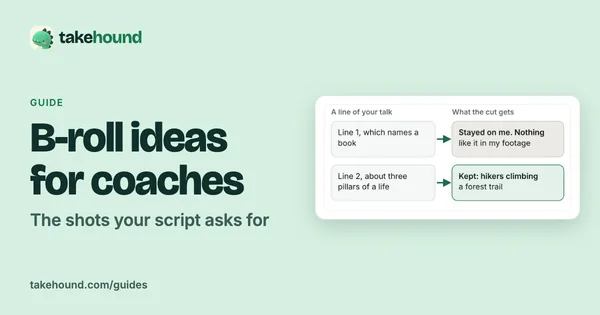
- B-roll ideas for coaches: the shots your script asks for
What one real 50-second talk asked for, line by line, and a checklist of 20 shots to film or find in your camera roll.
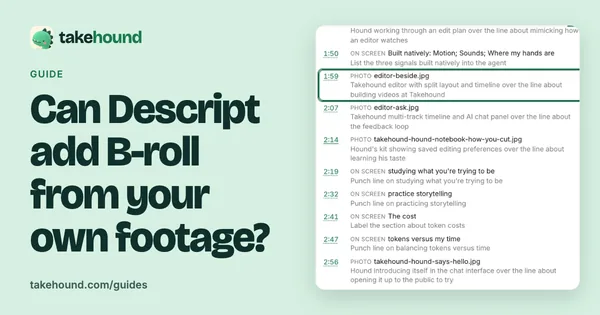
- How to add your own B-roll in Descript, in 6 steps
Yes: drag your own clips onto the script as layers, or ask Underlord. Six steps by hand, and where Takehound differs.
- How to import FCPXML into DaVinci Resolve or Final Cut Pro
In Resolve, File > Import > Timeline. In Final Cut Pro, File > Import > XML. Then relink missing clips to your footage folder.