Guide
B-roll in top talking-head YouTube videos: three videos, measured
In the first five minutes of one video each by Ali Abdaal, Vinh Giang and Alex Hormozi, a plain shot of the face was on screen 19% to 40% of the time. B-roll took 0%, 17% and 27%, and no stock footage was seen in any of the three. Most of what covers the face is not B-roll: it is a pad or whiteboard the creator writes on, a list that builds beside him, or words over the shot.
I'm Kyle. I built Takehound, an AI editor that places B-roll, so I have a stake in this question. I did not count these frames by hand: I had the first five minutes of each video sampled for this page by an AI assistant, one frame every 2 seconds, on 2026-11-09. The limits of that are listed below.
- 19% to 40%of the first five minutes showed a plain face
- 0%, 17%, 27%was B-roll, one figure for each video
- 0stock clips seen in 450 sampled frames
What was counted, and how
Three videos where one person talks to the camera, from three well-known creators. For each, this page samples the first five minutes: one frame every 2 seconds through YouTube's own embedded player, 150 frames a video and 450 in all, on 2026-11-09. Nothing was downloaded, and the frames were deleted after the count.
Each frame was sorted into one of seven kinds:
- Plain talking head. The speaker on camera and nothing else.
- Words over the speaker. The same shot, with words or graphics laid over it.
- List beside the speaker. He sits to one side and a list builds next to him, point by point.
- Pad or whiteboard. An overhead pad, an iPad or a whiteboard he writes on: his own second camera.
- Full-screen graphic. A graphic or slide that fills the screen.
- Screen recording. A recording of a screen.
- B-roll cutaway. The picture cuts away to other footage while he keeps talking.
The count, side by side
Seconds out of 300, and the share of the five minutes, for each kind.
| On screen | Ali Abdaal | Vinh Giang | Alex Hormozi |
|---|---|---|---|
| Plain talking head | 120 s, 40% | 88 s, 29% | 58 s, 19% |
| B-roll cutaway | 52 s, 17% | 82 s, 27% | 0 |
| Pad or whiteboard | 52 s, 17% | 22 s, 7% | 78 s, 26% |
| List beside the speaker | 0 | 66 s, 22% | 110 s, 37% |
| Words over the speaker | 62 s, 21% | 16 s, 5% | 10 s, 3% |
| Full-screen graphic | 6 s, 2% | 26 s, 9% | 40 s, 13% |
| Screen recording | 8 s, 3% | 0 | 4 s, 1% |
Each frame stands for 2 seconds. Shares are rounded to a whole percent.
| In five minutes | Ali Abdaal | Vinh Giang | Alex Hormozi |
|---|---|---|---|
| B-roll cutaways | 9, 52 s in all | 4, 82 s in all | 0 |
| Length of a cutaway | median 6 s, longest 10 s | 8, 8, 30 and 36 s | none |
| Longest plain stretch | 24 s | 18 s | 32 s |
| Median plain stretch | 6 s | 4 s | 2 s |
| Picture changed kind | about every 6 s | about every 10 s | about every 11.5 s |
| First frame that was not plain | at 0 s | at 2 s | at 2 s |
How often the picture changed is a floor: a cut from one shot to another of the same kind is not counted.
Each video, and where its cutaways come from
- Ali Abdaal, "If I Started a YouTube Channel in 2026, I'd Do This" (13:15 long). 9 cutaways in five minutes, 52 seconds in all, 17% of the time. The median cutaway ran 6 seconds and the longest 10. They show food and coffee in a cafe, Ali at a laptop in a cafe, a desk and studio setup, Ali outdoors with a laptop, close-ups of his own desk items such as books and pens, and a clip of Ali in another room. Each one looked like his own footage. The rest of the cover is words over him (21%) and an overhead pad (17%), and the picture changed kind about every 6 seconds, the fastest of the three.
- Vinh Giang, "How to Talk to ANYONE (Once You Know Their Color!)" (17:09 long). The most B-roll of the three, 27%, in just 4 cutaways: 8, 8, 30 and 36 seconds. The two short ones are his own event and stage footage. The 30-second one is four men holding coloured markers, staged for this video, and the 36-second one is an acted office skit with Vinh and another man. So 66 of the 82 seconds were scenes staged for the video. A list beside him took another 22%.
- Alex Hormozi, "If You Want To Create Wealth In 2026, Watch This (4 Paths)" (25:13 long). No B-roll cutaway at all, and the least plain face of the three, 19%. In place of cutaways: lists that build beside him (37%), an overhead whiteboard he draws on (26%) and full-screen graphics (13%).
What works in all three
These are observations from three videos, not laws.
- A plain face does not stay up for long. The longest plain stretch was 24, 18 and 32 seconds, and the median plain stretch was 6, 4 and 2 seconds. The first frame that was not plain came at 0, 2 and 2 seconds.
- Most of the cover is not B-roll. It is something to look at that the creator makes: a pad, a list, words. Those kinds, with graphics and screen recordings, filled 128, 130 and 242 of the 300 seconds. B-roll filled 52, 82 and 0.
- The B-roll is theirs. It is the creator's own footage or a scene shot for that video. No stock clip was seen in the sample.
What a solo creator cannot copy, and what they can
- Hard to copy alone: staged scenes. Vinh's two long cutaways have other people in them and were shot for that one video. That is a shoot, not a clip you already have.
- Hard to copy alone: lists and graphics that build. The lists beside Hormozi and his full-screen graphics are motion graphics, made again for each video.
- Can copy: short clips of your own life. Ali's kind of cutaway is about 6 seconds of a cafe, a laptop, a desk or a book. A phone films that.
- Can copy: an overhead pad. A second camera, or an iPad, pointing down at what you write. It was 17% of Ali's five minutes and 26% of Hormozi's.
- Can copy: words or a simple list on screen. The key words of a line over the talking shot, or a short list beside you.
The slow step: your own clip, on the right line
The B-roll in these videos is the creator's own footage. Nobody can download it. So for each cutaway, someone has to find the right clip among everything the creator filmed and place it on the line it fits. In Ali's five minutes that happened 9 times.
That finding and placing is the slow step, and it is the part a solo creator skips when there is no time. The result is a plain face for the whole video, which none of these three does. Tools that place clips you filmed are compared in AI B-roll from your own footage.
The tool I built
Where Takehound fits
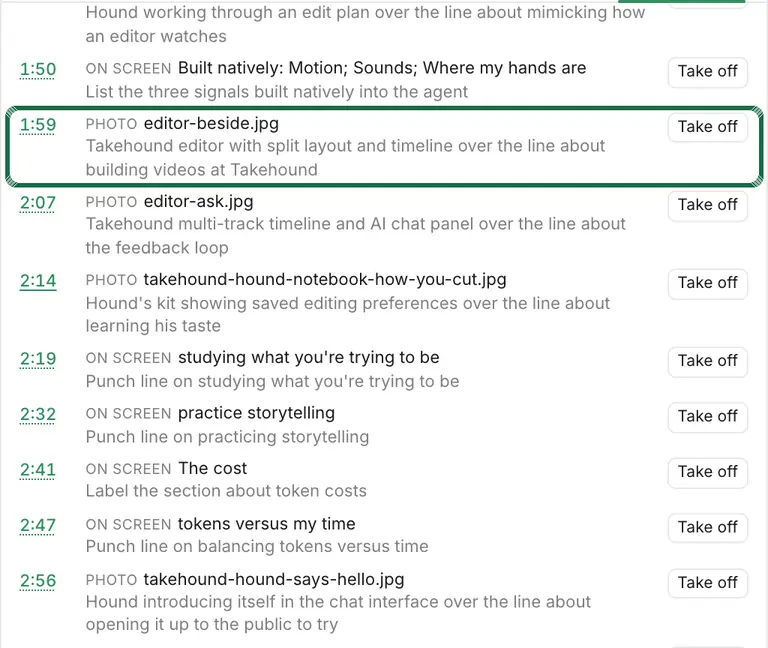
Takehound is mine, so weigh this part. It works on the slow step above: placing your own clips on the lines they fit. It does not film anything, stage a scene, or draw on a whiteboard for you.
Takehound is an AI video editor in Chrome on a laptop or desktop, for long talk-to-camera videos. Its agent is Hound, and on a talk he watches and listens to the cut. One press makes a first pass on your recording: he cuts long pauses, filler words and repeated takes, places your own footage on the lines it fits, and puts key lines on screen, with a reason for each change. The button says how long it should take before you press it.
B-roll is only your own footage, never stock or generated, and a line none of it fits stays on you as a gap instead of getting a wrong clip. A book, product or site you name may go up as a reference, with its source, marked as not cleared for you: he may add one without being asked, and you take it off or carry the rights yourself. Steer him in plain words, and he learns how you cut. Then export an MP4, or a timeline (FCPXML) that imports into DaVinci Resolve, where its clips then need relinking to your footage. It does not export to Premiere, and the file has not been opened in Final Cut.
Sign in with Google for a free first video, up to 30 minutes. See privacy.
See how Takehound worksLimits of this count
- One video for each creator. Another video from the same channel could count differently.
- The first five minutes. The rest of each video was not sampled.
- One frame every 2 seconds. Anything shorter than 2 seconds can be missed, and every length here is to the nearest 2 seconds.
- Kinds judged by looking. An AI assistant sorted each small frame into a kind by what it showed. I did not check each frame by hand.
- "His own footage" is a judgement. It means the clip looked like the creator's own, not that its credits were checked.
- One pick was dropped. An earlier Hormozi pick, his $10M service business video, is a multi-camera workshop with a guest, not one person talking to a camera.
Sources
The three videos, each read 2026-11-09 through YouTube's embedded player. Nothing was downloaded.
- Ali Abdaal, "If I Started a YouTube Channel in 2026, I'd Do This", 13:15 long: youtube.com/watch?v=T2M9hSswlIs, read 2026-11-09.
- Vinh Giang, "How to Talk to ANYONE (Once You Know Their Color!)", 17:09 long: youtube.com/watch?v=ikbcrpowlIs, read 2026-11-09.
- Alex Hormozi, "If You Want To Create Wealth In 2026, Watch This (4 Paths)", 25:13 long, 994K views and 5 months old when read: youtube.com/watch?v=sL16tsGafcQ, read 2026-11-09.
- The count: 150 frames from each video, sorted into the seven kinds above for this page on 2026-11-09.
Questions
How much B-roll do top YouTubers use?
In this sample, 0%, 17% and 27% of the first five minutes: none in Alex Hormozi's video, 9 cutaways in Ali Abdaal's and 4 in Vinh Giang's. That is one video each, sampled 2026-11-09, so read it as three examples.
Do big YouTubers use stock footage?
None was seen in the 450 frames sampled here. The cutaways looked like the creator's own footage or scenes staged for the video. That is a judgement from the frames, not a check of credits, and the rest of each video was not sampled.
How long should a B-roll cutaway be?
Ali Abdaal's 9 cutaways had a median of 6 seconds and the longest ran 10. Vinh Giang's ran 8, 8, 30 and 36 seconds, and the two long ones were acted scenes, not clips laid over a line.
How long do they stay on a plain talking head?
Not long. The longest plain stretch was 24, 18 and 32 seconds, and the median was 6, 4 and 2 seconds. In all, a plain face filled 19% to 40% of the five minutes.
Can a talking-head video work with no B-roll?
Alex Hormozi's sample had no cutaway, and a plain face only 19% of the time. The cover was a whiteboard he draws on (26%), lists that build beside him (37%) and full-screen graphics (13%).
More guides
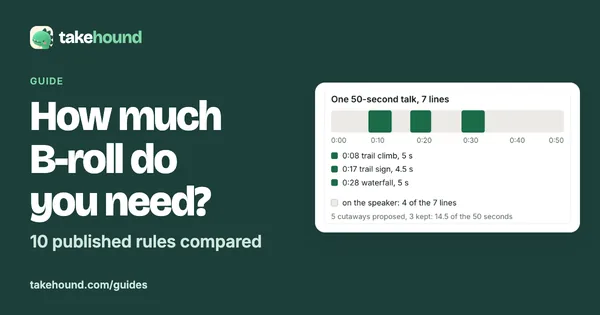
- How much B-roll do you need? 10 published rules compared
Four of ten published rules say film 4 to 6 times, one says 5 to 10. All ten side by side, and a count from your own script.
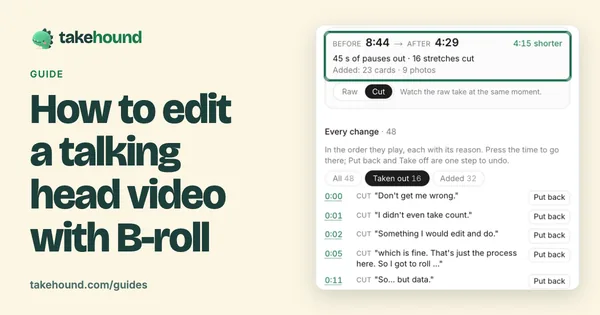
- How to edit a talking head video with B-roll
When to cut away or stay on the speaker, shown cut by cut on one real 50-second talk.
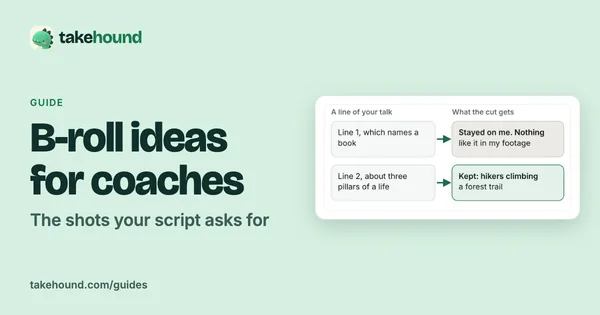
- B-roll ideas for coaches: the shots your script asks for
What one real 50-second talk asked for, line by line, and a checklist of 20 shots to film or find in your camera roll.